notes
GOLDSMITHS FOLLOWS A FAMILIAR SCRIPT
Current protests against the removal of MA Art and Politics at Goldsmiths
[ Published in The Leopard, issue 51, March 2026]
Another quietly proposed restructuring by Goldsmiths has begun protests against the merger of MA Art and Politics (MAAP), a degree that has long bolstered the university’s reputation and is now deemed unsustainable under budgetary pressure. Once again, students are responding to circulating proposals that appear thinly justified and have yet to receive formal notification.Lets be clear, this has happened before. In 2014, MA Participatory and Community Arts, established in 2004, was axed following what was described as a late departmental response to financial strain. In 2022 and 2024, MA Queer History and MA Black History also suffered uncertainty, and Dr Justin Bengry, course director for MA Queer History, was made redundant without prior consultation. On each occasion, Goldsmiths faced serious collective pressure from students and staff, and in some cases proposals were reconsidered or paused during consultation.MAAP is now in a precarious position. The department has reportedly been instructed to reduce programmes to a single MA, merging Art & Politics with Global Politics and Activism. The question that is difficult to answer is why is little consultation continuing to be standard practice when prior experience has repeatedly shown it to be a central critique. A petition has called for full transparency on financial justifications and serious consultation into alternatives.These protests evidence larger concerns about Goldsmiths’ failure to handle institutional priorities. A merger of courses ‘critical’ to the university’s academic identity, justified solely by budget considerations, leads only to scrutiny of trust in the institution’s priorities.As the campaign poster says, “You can’t market radicalism and cut Art and Politics.” Students are aware of wider financial pressures, but each threat to specialist degrees dedicated to progressive contemporary higher education demands institutional accountability and clarity.
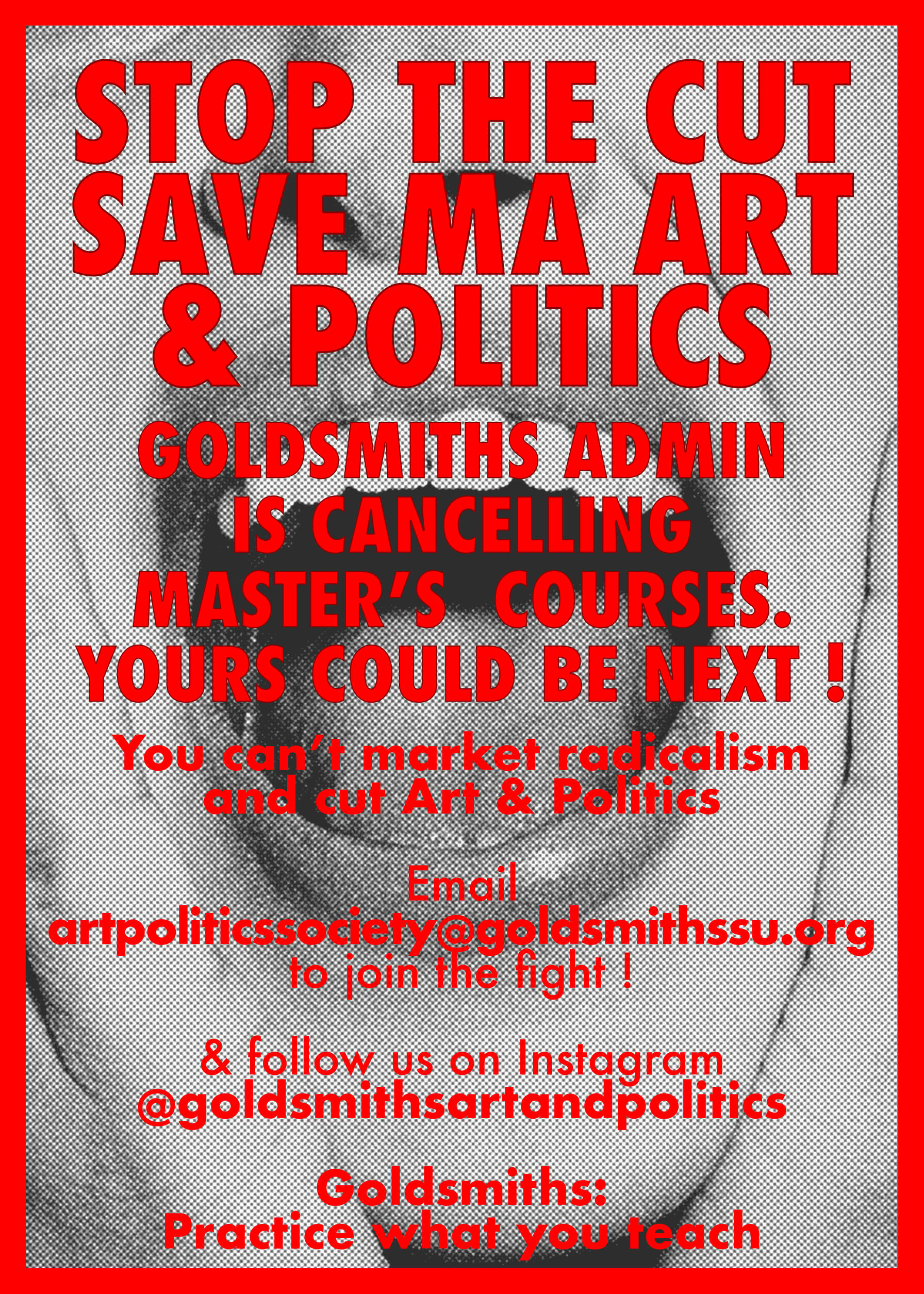
MA Art & Politics, Sofia Wilkinson-Steel, 2026
Patronage Consolidation and the Limits of Antagonism in Contemporary British Art
About the changing conditions of artistic dissent
[Written in February 2026]
I often feel we are in need of a highly radical art movement, one that is debated on the front cover of every main newspaper in the UK. Take, for example, the moral panic surrounding the Aesthetic Movement in the late 19th century. The movement protested against academically influenced traditional art, in favour of exploring themes of natural beauty and desire, allowing a response from the viewer elicited through multiple senses to deepen the experience. The Aestheticists rejected the increasing industrialisation around them, and by the later part of the century they reached a wide audience, who were both curious and critical of their contribution to the arts, as well as British society. A running comic by Du Maurier mocking the aesthetes is one example of the extent to which the movement entered public discourse.
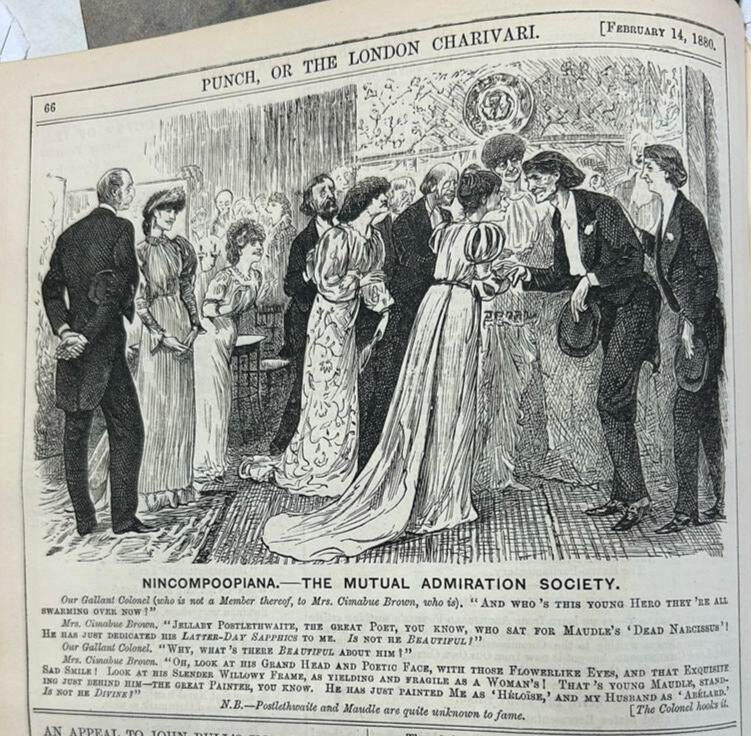
George Louis du Maurier, “Nincompoopiana---The Mutual Admiration Society,” in Punch Magazine, 1880.
Some scholars have drawn comparisons between the present and the 19th century in relation to austerity and crises in art criticism. However, recent coverage of the arts often appears limited to brief reports of funding reductions, especially those affecting major institutions, and searches for 'key artists of 2026' increasingly produce discourse solely focused on investment value and immediate financial return. More notably, there appears to be a relative lack of sustained protest by key figures within the arts world. When examining public funding and market data, the UK faces prolonged austerity in cultural spending, alongside a deteriorating public cultural system, even as financial demand and consolidation within the global and British art market continue to expand.Since the 1990s, the shift in art world dominance from public to private patronage has become more visible in the UK. Over the same period, material conditions have grown less accessible for younger generations entering the field. I want to consider the period between 1990 to now, focusing on higher education, housing, studio costs, public funding structures, and art market growth, to examine if contemporary patronage systems incentivise neutrality. An important question is whether a set of intertwined economic and institutional conditions now discipline vocality among critics, artists, institutions, and charities, and how that transformation might be understood historically.'Artistic genius' can manifest out of the raw and struggling artist, one who made something out of nothing, who appeared out of thin air determined to radically compromise contemporary traditions. Unfortunately though, this is hardly a common appearance in recent decades. One key element of this discussion is the role of higher education, which undoubtedly provides invaluable networks and opportunities allowing access to the arts sector. Most founders of the largest contemporary galleries in London have academic backgrounds, and entry frequently depends on experience tied to internships, summer schemes, paid for gallery visits, or through institutional ties. In 1962, England introduced free higher education with maintenance grants, positioning education as public investment into national intellectual capital, later to be repaid through progressive taxation. By the late 1990s, maintenance grants had become loans, and Tony Blair introduced a £1,000 annual tuition fee. By 2010, under the coalition government, this fee rose to £9,000, and by 2027 this figure is projected to reach £10,050. The perception of higher education, especially education focused on the arts, has slowly moved from a social right for young citizens, to students exercising a choice to invest in a product that will (hopefully) lead to prosperity.During my own undergraduate degree beginning in 2021, there was a pressure to choose a degree that guaranteed employment, widely acknowledged across all students. Now, while some are facing close to 6 figures of debt before finishing qualifications related to certain career paths, a debt that increases annually from high levels of interest, the question of whether one should attempt to study the arts academically is financially charged. For others, degrees within the arts can be easily dismissed as frivolous. Nonetheless, access to stable work in the arts depends on precisely these somewhat insecure institutional pathways.Housing precarity exacerbates similar economic problems. In London, rents increased by 38% between 2005 and 2016 while earnings rose by only 21%. Twenty-nine percent of homes are privately rented, well above national average. For those wanting a space to create art, LAASN data indicates average studio sizes have been shrinking from around 500 sq ft to 200-250 sq ft, alongside rent increases of 10% between 2022 and 2024. Where providers own buildings, LAASN asserts that rents could lowered by up to 48%. How does ownership of property and space in this context, become the defining factor for stability within the creative field? Leasing and short-term contracts gatekeep and delay stability for artists to plan long-term projects. Rising costs can lead to artists opting for short-term income instead of projects that may not see a financial return fast enough. The financial buffer that provides artists the ability to experiment continues to contract, which in turn limits antagonisms, as the capacity to absorb failures diminishes.
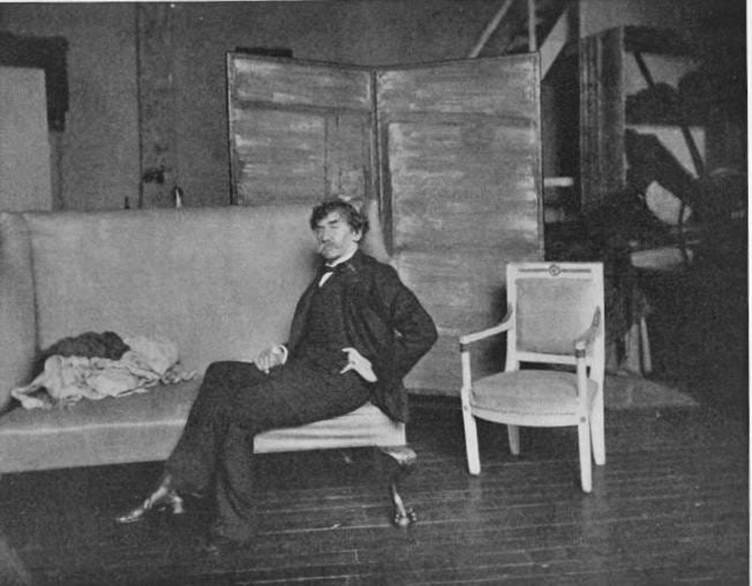
Paul Marsan Dornac, Portrait of Whistler in his studio, 1905, Victorian Web.
If the artists fundamental and private conditions might complicate the ability for antagonistic experimentation, we must ask if public funding compensate? After the Second World War, the establishment of the Arts Council of Great Britain, now Arts Council England (ACE), formalised the principle that the state had a responsibility to support art and cultural production at arm’s length. Post-war legislation empowered local authorities to levy rates solely to support the arts, a provision seen as a democratic commitment to public culture.Since 2010, however, there has been a fall of £2.3bn in real terms in local council spending. Core spending power for local authorities has also declined significantly, increasing the pressure for alternative cultural provisions. Key funding bodies, such as ACE and the Department for Digital, Culture, Media & Sport (DCMS), have taken more restricted funding opportunities, much of them only available for a few years. National Lottery grants have increased, but restricted funds also reduce institutional autonomy through limiting the power to allocate resources towards general infrastructural stability, thus reducing protection when facing external economic crises. DCMS core funding accounted for only 0.17% of total public spending per person in 2022, down from 18% in 2010, and revenue funding for cultural services has falling sharply.When 90% of available funding is short term, organisations internalise the same caution as an artist. A feedback loop is created between organisations and private investments, partly due to limited policy implementation during this shift. Internal motivations must reorientate around growth metrics, resulting in precarity that is not mitigated at a systemic level.
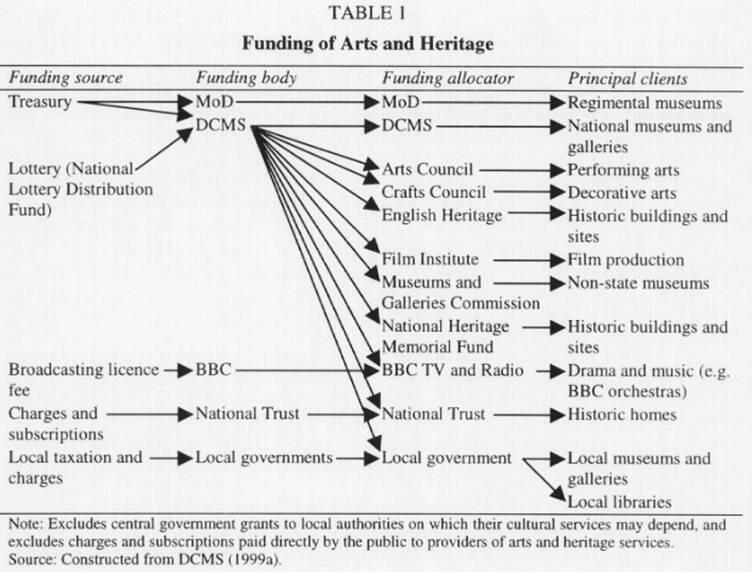
DCMS, Funding of Arts and Heritage, 1999, reproduced from History & Policy.
My assumption until researching was that this slump in the art world extended into the market. I was surprised to find out that global and British art market data provides quantitative evidence of both recovery and expansion following the 2008 financial crash. The UK holds a dominant share of the European Community art market. Sales values and transaction volumes rebounded quickly over the last two decades, and the creative industries contribute over £124bn to the UK economy. It is clear then, that capital in the arts has concentrated itself into specific areas.I do not argue the private markets are inherently destructive, rather a shift in consolidation translates as a shift in leverage. Large commercial galleries in London operate on a vertical business model, retaining profits and expanding primarily through global investor relationships. As public funding ability worsen alongside intensified accumulation of capital, patronage must centralise. Financial survival in the arts depends more heavily on wealth networks, and antagonism risks losing exhibition opportunities and relationships that defend artistic authorship.There is currently no clear evidence of overt censorship in the arts, but constraint itself a structural process. The economic cost of artistic controversy is high. Antagonism requires affording to fail and try again. Without economic independence, especially for younger generations, antagonism and dissent migrates away from dominant market visibility. A cycle emerges: limited access means limited protest, consolidation increases dependence, dependence increases caution, and debates become invisible. Invisibility weakens public engagement, and with it the political defence of funding.Art history will likely read this period as inseparable from the economic conditions to which it exists in. My conclusive question is why art has so little visibility in a public discourse that once felt shaped by it? Is silence still an individual choice? Is silence just the production of current economic shifts? If the answer is yes, where must reform begin?
- Robert Anderson, “University Fees in Historical Perspective,” History & Policy, 2016.
- Department for Education, Changes to tuition fees: 2026 to 2027 academic year and 2027 to 2028 academic year, Gov.uk, 2025
- Catarina Finnerty, Rebecca Bicocchi, Understanding Recent Rental Trends in London’s Private Rented Market, Greater London Authority Housing and Land HRN 09, 2023, 4.
- London’s Affordable Artists Studio Network (LAASN), 2024 Research, LAASN, 2024
- Joanna Bialynicka-Birula, “Changes in the Global Art Market,” Oeconomia Copernicana, vol. 9 no. 4, 2018, 699.
- Creative EC ONOM, “UK creative industries add £124bn to UK economy,” Scribbr, 2024